If you’re looking at a career in real estate, you’ve probably seen agent, broker and Realtor used as though they mean the same thing. They don’t. Two of them are licenses with different legal authority, and the third isn’t a license at all.
Getting this straight matters for more than terminology. It determines what you’re allowed to do, who has to supervise you, how much education New York requires, and how long it takes before you can work for yourself.
The Short Version
A salesperson (what most people mean by “agent”) is licensed to help clients buy, sell and rent, but must work under a sponsoring broker.
A broker holds a higher license and can operate independently, run a brokerage and supervise salespeople.
A Realtor is neither. It’s a membership in the National Association of Realtors, held by agents and brokers alike, and you can practice real estate in New York without ever becoming one.
What is a Real Estate Salesperson?
A licensed real estate salesperson is usually where a real estate career starts. You’re licensed to represent clients in buying, selling and renting property — but you cannot operate on your own. Every salesperson works under a sponsoring broker who supervises their activity and accepts their listings.
What a Salesperson Does
- Shows properties to buyers and renters
- Prepares and submits purchase offers
- Works through contracts and disclosures under broker guidance
- Carries out market research and pricing evaluations
- Guides clients through to closing
The supervision isn’t a formality. Legally, listings negotiated by a salesperson are accepted by the representative broker, and the broker is responsible for the conduct of the salespeople under them.
How To Become a Salesperson in New York
- Be 18 or older and hold a current New York photo driver license or non-driver ID
- Complete 77 hours of approved qualifying education
- Pass a proctored school exam, then the Department of State written examination ($15)
- Find a sponsoring New York broker
- Apply to the Department of State — $65, for a two-year license
There’s no education prerequisite. New York doesn’t require a high school diploma or a GED, and no prior sales experience is needed. Our 77-hour salesperson course covers the qualifying education in full.
What is a Real Estate Broker?
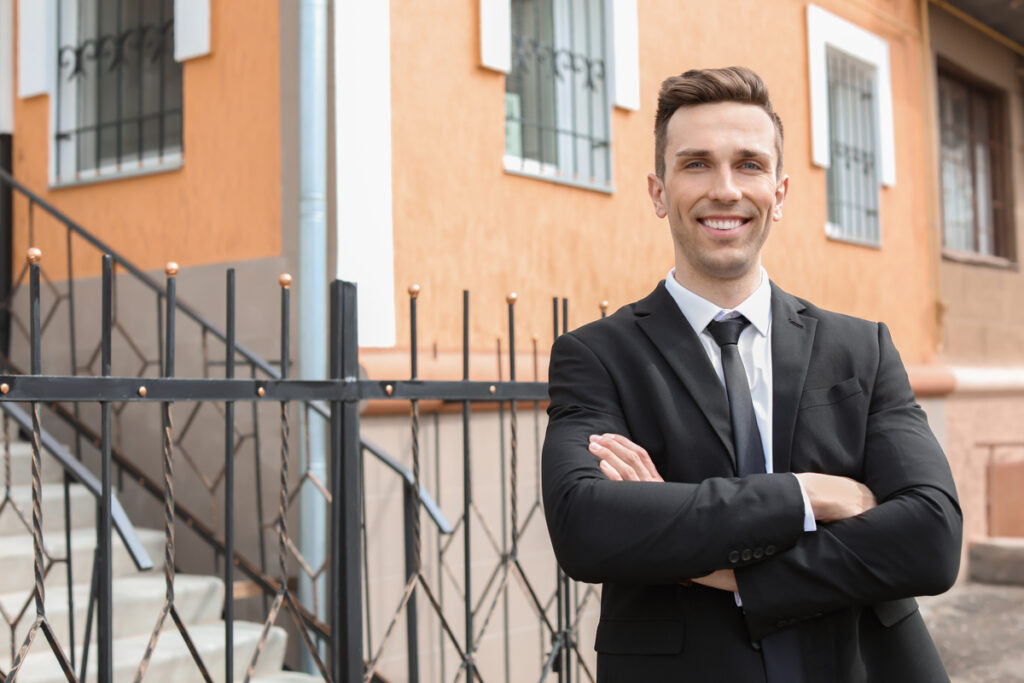
A broker holds a senior license. Brokers can do everything a salesperson does, and then some: operate independently, open and run a brokerage, and supervise salespeople working under them.
What a Broker Does
- Runs a brokerage or real estate office
- Supervises and mentors licensed salespeople
- Oversees transactions for legal and ethical compliance
- Handles trust accounts and escrow funds
- Negotiates commission structures and sets office policy
The Three Kinds of Broker
Associate Broker — holds a full broker license but chooses to work under another broker rather than run their own office.
Managing Broker — runs the day-to-day operations of an office and is accountable for supervision and compliance.
Principal or Designated Broker — legally responsible for the brokerage and everyone licensed under it.
One point worth being clear about, because it’s widely misunderstood: an associate broker is a fully licensed broker. The qualifying education, the experience requirement and the state examination are identical to a principal broker’s. The only difference is the choice to practice under someone else’s supervision rather than independently.
How You Become A Broker in New York
The broker license has two requirements that the salesperson license doesn’t: more education, and documented experience.
On education, New York requires 152 hours in total. The salesperson course you’ve already completed covers part of it; the 75-hour broker course covers the rest, along with two hours of fair housing and implicit bias training.
On experience, you need either two years as a licensed salesperson or three years in the general real estate business — and in both cases you have to document that experience as points. Points are awarded per transaction and weighted by type: a closed residential sale is worth 250, a residential rental 25. You need 3,500 points on the salesperson route, or 5,250 on the general experience route.
The points requirement catches more people out than the coursework does. Three and a half thousand points works out to roughly fourteen closed home sales — achievable in two years for a sales-focused agent, and considerably harder for someone working mainly in rentals.
You must also be at least 20 years old, and the application fee is $185 for a two-year license.
So What is a Realtor?
This is the term that causes the most confusion, because it isn’t a license.
Realtor is a trademarked membership. It means the person belongs to the National Association of Realtors and has agreed to abide by its Code of Ethics. Both salespeople and brokers can be Realtors. Plenty of licensed agents in New York aren’t.
Membership usually comes through a local board and carries annual dues, and it brings access to certain MLS systems, professional development and NAR’s advocacy work. What it does not do is change what you are legally permitted to do. Your license does that.
Put Simply: your license (salesperson or broker) is granted by the New York Department of State and sets your legal authority. Your Realtor status is a professional membership you opt into afterwards. You need the first. The second is a choice.
Salesperson vs Broker at a Glance
Since Realtor status sits on top of either license rather than alongside them, the real comparison is between the two licenses.
| Salesperson | Broker | |
|---|---|---|
| Minimum age | 18 | 20 |
| Qualifying education | 77 hours | 152 hours total, including the 75-hour broker course |
| Experience required | None | 2 years licensed, or 3 years general — plus 3,500 or 5,250 points |
| Supervision | Must work under a sponsoring broker | Can operate independently |
| Can hire agents | No | Yes |
| Holds client funds | No | Yes — trust and escrow accounts |
| Application fee | $65 / two years | $185 / two years |
| Earnings | Commission, usually split with the broker | Full commission, plus overrides on agents |
Which Path is Right For You?
In practice this isn’t an either/or. New York requires you to hold a salesperson license first — the broker license is built on top of it, both in education and in experience. The real question is how quickly you want to move up.
Start as a Salesperson
If you’re new to real estate, this is the only way in. It’s also genuinely useful time: you learn how deals actually close, build a client base, and work out what kind of real estate you like, all with an experienced broker responsible for the compliance side. Most brokers began here.
Move Up to Broker When You're Ready
The broker license makes sense when you want to work for yourself, open your own brokerage, or build and lead a team. It brings a bigger share of the commission and overrides the agents under you — along with legal and financial responsibility for everything that happens under your license.
You can also hold a broker license and choose not to run an office. That’s what associate broker status is for, and for many people it’s the sensible middle step.
Questions Worth Asking Yourself
- Do you want to run your own business, or focus on your own clients?
- Are you comfortable being legally accountable for other people's work?
- Do you enjoy training and managing, or would you rather be selling?
- Have you accumulated (or can you accumulate) the transaction points the state requires?
That last one is worth checking early. Plenty of agents decide to go for their broker license and then find the points are the bottleneck, not the course.
Take The Next Step
Whichever direction you’re heading, the education is the part you can start today. REEDU’s salesperson course covers the qualifying education New York requires for your first license, and the broker course covers the 75 hours you’ll need to move up — both online and self-paced.
Not sure you’re eligible yet? Our guide to salesperson eligibility walks through the requirements in detail, including the ones people assume apply and don’t.
Ready to get started? Both courses are online, self-paced, and approved by the New York Department of State.